The Recycler (“Catador”)
 We didn’t have our own house. Our home was underneath that canopy. There we slept, ate, and bathed. So, we took care of that place with affection… as if it were our home.
Introduction: Julio Cesar works together with his wife and step-daughter at ASMARE, an association of “catadores” in Belo Horizonte. Catadores are individuals who search for and collect recyclable materials to be sold to scrap-yards and recyclers. ASMARE provides a secure, covered space for workers to unload, separate and weigh their materials. Five to six days per week, Julio hauls a self-made cart throughout Belo Horizonte, searching for paper, cardboard, cans, and plastic containers, among other items. At the end of a good day, he returns to ASMARE with more than 900 pounds of materials and trash, which his wife and step-daughter separate into specific batches for weighing.
Belo Horizonte, Brazil, 2006
An Accident
I was born in Contagem, in the metropolitan region of Belo Horizonte. I have six brothers and sisters. The youngest is 25, I am 28, my sister above me is 30, another is 31, my brother is 32, another sister is 33 and the oldest is 34. When my mother was pregnant with my youngest sister, we moved to São Paulo, to São Bernardo do Campo. My father worked for a bus company there, worked as a mechanic. Only he had an accident. A nail, iron, I don’t know what he was welding, broke free and lodged inside his eye and he lost vision in one eye. So, my father had to return to Belo Horizonte to have surgery. This accident happened to him and he didn’t come back. After this accident happened, he found another woman. My mother went and decided to leave him. He drank too much, right? Drunken blows confusing their married life, he hit my mother a lot. I was real small. My mother was pregnant with my youngest sister, so it’s a long time that they are separated. It’s twenty some years. They are separated, but on paper they continue married.
Half Moldy Bread in the Neighborhood of Rapists
When my mother left my father she ended up giving birth to my youngest sister in São Paulo. One day arrived we had nothing to eat. It was soon after my mother left my father that we had this difficulty. To satisfy our hunger, my mother started to beg, she picked over things from the trash to give to us to eat. So, my mother searched for bread in the trash, bread that was half moldy. She removed the mold and gave the rest to us to eat. Sometimes we had nothing to eat; she arrived at home and made porridge for us, that thick porridge. São Bernardo do Campo, I don’t know if it is still like this there, but when we lived there it was called the “Neighborhood of Rapists” because it had many rapists. It was a “barra pesada” (1). So we were scared to death, even more so when night arrived. It was a favela. It was a very dangerous place. My mother, like, the little that she stayed in São Bernardo with us, always said it wasn’t safe for us to go out at night. Night arrived and you didn’t see anyone in the streets. Nobody! One time, four men arrived there early in the morning and knocked on our door. During this period, my mother was still there with us, thank God. Everyone was small, afraid, trembling. My mother assembled everyone. We didn’t have lights, right? My mother grabbed hold of a carving knife and said, “If they enter inside here, I am very sorry.” So, they knocked on the door, nobody responded. On our yard there was a tree trunk that we made into a bench and they grabbed this trunk, the four men, and hit on our door with this. Some three times. But God is so strong, but so strong, that something fell behind that door preventing it from opening.
An Urgent Operation
My mother had to return to Belo Horizonte to have an urgent operation and ended up abandoning us there, me and my brother and sisters. She ended up abandoning us in São Paulo because her case was an emergency: life or death. So she left us there like this, with God really, because she did not have the financial means to bring everyone with her. We remained alone there a long enough time. I was two or three years old during that period. My sister found some work there at an orphanage to feed us (2). She went there and spoke with the owner to find work, to clean there, for the owner to give us leftover soup for lunch and dinner. For us to survive, she worked at the orphanage in return for leftover soup.
Later my mother returned, after some five, six months. She returned and she found work, an odd job. She went to a company called Avon, which sells perfume, something like this. There we made those little paper crates, like little chess boxes, to place the glass bottles so they wouldn’t hit one another, so they wouldn’t break. So, she went there to do this, started to assemble those paper crates, took them there and they paid for the quantity that we put together. Later, I don’t know what happened this time, my mother had to abandon us again in São Paulo and return quickly to Belo Horizonte. It had something to do with the surgery she had (3). She returned, like, really quickly. She didn’t even stay one month with us there. She left the responsibility in our hands, but we were minors and the owner of the factory did not accept this and cancelled our work.
So, my mother was in Belo Horizonte. This time she took a long time! My sister returned to work for the owner of the orphanage. She returned to do the same thing: she worked and received soup. It was painful. It’s like this, even more so the place that we lived because there were many rapists in the region. We had the house my mom left there with us. It was next to the highway. The real danger was further inside the favela. But even so, we were afraid, we didn’t have a father, we didn’t have a mother to protect us from danger. Like, it’s like this, I was small, right? For me it was real normal. I came to know that it wasn’t normal after we started to grow up. We stayed there alone and after three months a lady appeared and resolved to take us to a farm.
The Farm
A group arrived there and saw that our situation was real difficult. A lady brought us a cesta with loads of food ready to eat (4). So, they talked with us, asked if we had a mother, a father. They took the oldest, explained the situation to her. I was going to turn three I think. It was December, right? So, I was still going to turn three. The lady grabbed some not-very-chic things of ours and left the house there. I don’t even know what happened to the house. It remained there, we wanted to leave. It was dangerous. They took us away. It was two couples who were owners of the farm. I don’t know if they were brothers and sisters, if they were friends, I only know that one of the couples was Nanci and Osmar and the other was Tade and Matia. Of them, I remember their first names. This I don’t forget. I want to meet them to thank them for what they did for us because, at the time we were without mother or father, they took us in. They were father and mother for us. We stayed there for some two years. They received us with open arms. They brought everything for us: clothes, medicine, everything. Everything that they gave to their children, they gave to us. We had all the food that you can think of there on the farm. You know how it is: there were horses, pigs, herds of cows… we took milk straight from the cows. It was a life anyone would ask for from God. Before we didn’t have all of these privileges, so we as much as made the most of it. We remained there on the farm, they even found a maid for us—a maid and everything.
The Maid
What succeeded in muddling our dream of continuing there on the farm was that maid they found for us. The old fashioned, they have a habit of praying. When having coffee, pray. When eating lunch, pray. When waking up, pray. When going to sleep, pray. So then, that maid had this obsession. It wasn’t that we didn’t like to pray or nothing. It’s as much as a good thing and everything. But we were small, we still didn’t know how to pray. So then, she would do this: every day one of us had to start to praying. We couldn’t start with errors. If we started wrong, she would beat us as if she was hitting adults. She really beat us. One day she grabbed my brother and left dragging him on the floor, but she really beat him, just because he did not know how to pray correctly. Every day we were beaten by her hand. We commented to the farm owners and they thought we were lying and everything. Only, we showed our bodies, how they were full of bruises and everything. They smelled a rat and talked with her. My brother and sisters went there and told them like this, “Look, make a decision, take her away from here or we are going to kill her.” We were envisioning the moment that she grab and throw us against the wall in a harsh way and kill us. They removed the maid on the same day that my brother and sisters told them, “Take her away, or tonight she doesn’t pass.” They ordered her to get her things and sent her away for just cause.
Mother Returns
One week later my mother arrived (5). She went to São Bernardo and found our address. She arrived at the farm and my brother and sisters told her about the maid. We explained the situation to her. My mother listened to everything and said she was going to take us away. We wanted her to stay there with us, insisted that she stay there and told her that only the documents of me and my younger sister were lacking for them to put the farm in our names. They already had the documents of my older brother and sisters, who already were studying where we lived. They were going to put everything in our names. It was going to be for the seven of us. It wasn’t going to be in the name of just one of us, it was going to be the seven of us. I think, like, if it wasn’t for these problems that happened, I think we would have continued there because the farm would have been ours. What arrived to muddle our dream of continuing there was that maid they found for us. My mother said, “No let’s go.” She took everyone. She brought us to Belo Horizonte, like, without using her head. She didn’t even know where to put us. I would have liked to have taken advantage of that life we had there on the farm.
Return to Belo Horizonte, The Streets
We returned from São Paulo and went to live at my aunt’s house. To live at a relative’s house, you know how it is: everything that is bad is so-and-so’s kid. My mother was annoyed with that there: her sister’s children did wrong things and the blame always fell on us. We stayed there one month, then my mother decided to leave for the streets with us and everything. I already had turned five. We started to live in the streets underneath a canopy near the bus station: me, my mother, my six siblings, everyone. During this period, my father lived in Marimar, there in Esmeralda, he worked on a farm… and us there in the streets. I continued living in the streets until the age of 16. I always lived in different places. Fiscal arrived, we ran, fiscal came, we took off (6). Home was, like, an old abandoned house. We lived in an old house for a while.
The Vice of Begging for Money
My mother is a good person. The problem with my mother is, like, she put us out to beg for money. It is something that I didn’t like. I thought it was ugly and it is the type of thing you end up getting addicted to. You grow up, starting at an early age, “Hey man, give me some change. Give me some help.” So then, the youngster grows up like that, with the vice of begging, everything he sees he begs for. Someone passes with a biscuit in the street, “Give me some.” Another passes eating ice cream, “Give me some.” It becomes a vice to beg for things, so I didn’t like that of my mother.
We were suffering many hardships in the streets, passing a lot of humiliation. When we approached others, begging, they ordered you to “weed a lot,” ordered you to do this and I don’t know what else. “Ah, where is your father, your mother? I didn’t put you in this world.” We got a lot of this. It was really bad. We begged and made a lot, but my mother did not know what to do with the money. If she knew how to manage that money we made day-to-day, we would have a mansion there just by begging for money. In the old days, you asked for change and people gave you bills. Today the situation is even difficult for the well-off, not just for us. In the past, you wandered around there, found a shoe box and walked around, you returned with fifty, sixty reis (US$20 to US$25) inside the box.
I say if it depends on me to return, to spend just one night in the street, I wouldn’t do it because it is terrible. It is painful. Only those who have lived this know. It’s stuff that I like really—those times begging—I don’t like to remember. I want to erase it from my mind. We grew up with that, with a habit of always begging for things. I begged until I turned 16 or 17. But if it becomes necessary to beg again, to satisfy my children’s’ hunger, I would do it. I think like this: it is better to beg than to steal and not get away with it. Even then, to steal and get away with it is ugly because I would be setting a bad example for my kids. In the future they can say, “My father taught us what he taught us: we never have to steal or mug nobody.”
Sometimes I pass by kids begging and think, ‘It’s not even their decision.’ Understand? Mom and dad force them. Many kids these days are begging to support vices of their parents. Drinking, smoking, understand? Sometimes it is not to eat, to buy a blanket, medicine. It is parents using their kids. But it is also an unemployed father because the market requires schooling. Imagine a vagabond like me. He approaches a good firm there looking for work, the guy will look at him, see a filthy candidate, he won’t even ask if he has schooling, professional training. The guy will receive a big “No.” So then, where does he find his money? He puts his kids out to beg.
Working Day and Night to support a Mother’s Drug Habit
There are times I feel annoyed by how much I worked in my life, but really a lot. Sometimes I like stayed awake one week without sleeping, working day and night, just drinking coffee, or powdered guarana (7). I took that to stay awake because my mother put us out to work day and night. She spent the money on things… it was a drug habit really, she was a drug user. A lot of this money that we received was burned up on drugs. So then, we were really revolted by this. Sometimes we missed a night of sleep, stayed all night at a traffic light begging for money. So, like, we should have been completely revolted by life. My sisters should have become prostitutes, those women lowest in life. Me and my brother, we should have become criminals, scoundrels in life.
She was tranquil. She only changed when she didn’t have weed. Then she changed, understand? She had to have weed to calm down. She used marijuana, I think cocaine too. I didn’t even like to be nearby because they say kids do wrong things because they see their parents doing them. It’s like that business, if I arrive here and plant a good plant, later I will harvest a good fruit. She used, but she respected us. We knew that she used, but not in front of us. Understand? Anyone knows when a person is high. So, like, when we were growing up, we perceived this. We said, “Ugh, my mother is already going there. She is already going there.” Or a dealer would arrive and say, “Where is your mother?” A guy, when he is not addicted, finds twenty to give him their drugs. After the moment he is addicted, those twenty only come to take money that he doesn’t have.
The Start of Collecting Paper from Trash
When my sister turned two years old, we were living below the canopy of Mercado Novo (8). The pivetes threw a party for her, made a bunch of stuff for her there (9). We all sang “Happy Birthday.” So, we were there below that canopy and we saw people collecting paper and we asked them what they did with this. So the guy said, “There is a man there in front who buys this here.”
We said, “Oh, mom, let’s stop asking for handouts, let’s collect paper because there is a guy there in front who buys this.”
“Are you guys crazy?”
“No, a guy told us.”
So, with much difficulty, we started to collect on our own heads. We didn’t have a cart at the time. We started to collect without a cart, by hand, and we separated the trash there below the canopy. We carried the materials to a recycling yard and made our first small money. We were happy. So, we continued collecting on our heads, we did this for a long time. We collected and when we were under the canopy we cleaned the materials the way the man taught us. So, the man saw that we wanted to work for real and he found a cart for my mother. He told my mother, “I am going to find a cart for you because of your kids who I can see are committed people and all.” So he found a cart for my mom. She pushed the cart because everyone was small. So, my mother pushing there and we wandered around collecting by hand. During this time we were there at Mercado Novo. We lived there many years, some four or five years.
The Old House in Savassi and Capixaba
Today, if you arrive anywhere, the municipality comes and removes you at once. So then, we spent a long time at the Mercado. We left the Mercado and went to live there in Savassi (10). There, the first place that we stayed was an old house. This old house has already been demolished. It doesn’t exist any more. But there are times I pass there and say, “I already lived here.” I even talk to myself alone, “Oh what I already have lived here. If these streets here could talk… what I already did here, what confusion I have caused.” Because children you know how it is: when they are far from mom and dad, nothing can be done, they get into trouble. We stayed at this house for a little more than a year. Then the owner appeared, said “Excuse me,” and ordered us to the streets. We left.
We went to a canopy on Pernambuco Street and there we met this man, Capixaba. That Capixaba, I liked him a real lot. I don’t know what I saw in that Capixaba. To me he was the same as a father I never had. He was an excellent person. So, the day that this guy left, I even cried. You look at a person and see a person, like, with a good heart. That Capixaba had a good heart. Everything that I wanted, like right away, he was there right away. So it was the same thing as I open my mouth and say like, “Dad, give me that.” The guy would give it to me. “Dad, I hurt myself here.” The guy was there immediately. So, he is a person like I don’t forget. He lived with us in the streets some three years more or less. I thought, this guy is playing the role of my father. I know that on the day he left, I cried a lot, begged him not to go, but he said he had family there where he was going, and the like. It was Capixaba, the Paulista and Pernambuco who came to live with us. It seems like a little tale, but it isn’t. It is the real truth. So Capixaba left and the others remained. That Pernambuco also already took a lot of beatings there outside on the streets. I knew him ever since I was a small child. So I asked him if he had news of Capixaba, but nothing more, the guy disappeared for real. So, the neighborhood of Savassi was growing and becoming a neighborhood with more activity, right? With people from the middle class and everything, and people were hassling us, and the police went there and removed us. So we left Pernambuco Street and descended to Praça Tiradentes. We stretched out a canvas and lived there for a while.
Surviving with Help from Others
Many people turn to me and ask, “Do you have the courage to return to live in the streets?”
“No.”
Look, in principal it is difficult because today is not like the past. In the old days, you had many people who helped you. Understand? People really helped you from their hearts. When we were kids, people passed, brought hot water, a basin and gave us a bath.

Two small children taking baths at a recycling yard in Belo Horizonte.
One time I became ill in the street, they gave me a bath there below the canopy of the market, dressed me, took me to the hospital, interned me, accompanied me there… later after I got better, they delivered me to my mother. Understand? Every day they would go there and bring water for us to take a bath. So they were very caring people, those people from the butcher shop.
It’s that business: despite the difficulties that we passed in life, we managed to overcome them. Beyond having good souls, we met many people who helped us. Understand? They gave us support at the time we most needed it. We were kids and everything. So people came and helped with money, clothes and various other things. So, it was practically just an adventure for us, like a passing adventure, something that would pass. Understand? Only, over the course of years… the years passed and we ended up accepting that. The reality was: we didn’t have our own house. Our home was underneath that canopy. There we slept, ate, and bathed. So, we took care of that place with affection… as if it were our home.
Today people help you, but later they are collecting from you. They are collecting double what they did for you. And it’s not like this. Today you are here helping me… I will simply thank you because God will pay and help you later in double. Today people do what? They come call you “mendigo,” right (11)? They even use this word. They see a person lying in the middle of the street, they want to arrive and set them on fire, beat them up. They don’t think about tomorrow. Like a friend of mine fallen there, he couldn’t get up. I went there and asked, “Do you need some help?” Because I don’t know about my tomorrow. Tomorrow it could be me.
The Couple from France
When I was a youngster, a child really, I had a dream. My dream was to become a soccer player. Wherever there was a small field, a small sand lot, I lived playing informal matches. As an eight year old I already was in the middle of grown men. I played only with adults. Until today I play soccer. I wake up early—there is a team there near home—on the weekends I go there and play. So, my dream when I was little was that there.
A couple from France arrived and every weekend they would go there, a place called “malão.” The couple saw and admired me, understand? At the time I was eleven. I was a child. So, they went there, spoke with my mother. They didn’t speak great Portuguese, but we could understand them. They wanted to take me to France. It’s like this: illusion a child, put a fantasy in my head, approach my mother and say, “Why don’t you let him go with us to France? There he would become a professional soccer player and everything.” But I made a choice, right? Given my age, I think I made the right choice because it was not worth it if my family was here and I would be far away from them. I told them, “No. I don’t want to be happy alone, I want to share it with all of my family.” So, I didn’t want to go. They arrived, like the guy wanted to buy me from my mother. He wanted to buy me! Was it dangerous? At that time you heard about foreigners coming to Brazil purchasing children. That’s it, transporting them there, but to take organs from the children. They seemed like good people… ah, like, the bad we don’t recognize their faces. So I smelled a rat. I had a tough time sleeping at night, afraid that they would come and take me, without my mother, without my brother and sisters, I don’t know.
They continued passing by there. They brought fruits, a bunch of stuff for us to eat, trying to convince my mother. Well, at least this he alleged: “No, he plays soccer very well. There we work with other kids his age.” My mother said she would let me go if I decided to. I chose not to go. If it depended on my mother, I would have gone. She wanted me to go. It is something that remains stuck in my memory: if I had gone, would I have turned a professional soccer player? I think about this.
Studies in the Street
We studied one year, then took off a year. I completed first grade over some three, four years. I studied one year, stopped the next, studied one year, stopped the next. So there wasn’t any way for me to continue with my studies. Me and my sisters entered first grade, and I made it to third. Study or work. So, I told my mom, “As of today, I’m not studying anymore.” I put that in my head. I know I was making a bad decision, but it was a great difficulty. Sometimes I would go to class without lunch, without eating. I arrived there and they made a small snack before going into the classroom. So, it was really bad. Understand? The kids, the classmates made fun of us, said that we had nothing to eat at home, that we only went there to eat, you know? And it’s like this: I was an exemplary boy. I went to school to study. There inside the school a guy could hit me, curse my mother, my family, but I didn’t do anything to him. But outside the door and beyond, he didn’t repeat the same words because I already changed. I always was dedicated, I wanted to learn. So, I studied until third grade at Lucia dos Santos there in Carlos Pratos. I did my homework in the street. I had to ask others to buy my school materials.
Years later I resolved to return to study, and I completed a special course that they had there. It was only for people who had already completed fifth grade. I begged at the foot of the director to give me an opportunity because I wanted to study. So, she gave it to me, gave me a chance to finish fifth grade. I hadn’t even reached fourth, I had stopped in third. I didn’t know what would lie ahead, but I succeeded and managed to complete fifth. Things that I don’t know, I want to learn. Broken things that I find in the trash—old radios, that stuff—I take apart, fix, and make them work. So, I am curious, I have a desire to be someone in life.
Pepper Sauce
We lived in the street without protection, understand? So what we could count on was the divine protection of God. Sometimes drunks arrived, full of cachaça. We were afraid that those guys might come and set us on fire. Silly things happened to us, which could have been resolved easier with conversation, dialogue, than with violence. For example, we arrived at a restaurant, the owner of the restaurant ordered an employee to throw water on us, throw pepper sauce, just because we were asking for a little food. We were revolted by that and threw stones at the display window. Was that right? Or was he wrong? I think it was easier for him to talk with us than to order water, pepper sauce, be thrown at us. Understand? So, like, dialogue is prettier in the lives of human beings. If one day I succeed in life, like to be able to open a restaurant, I don’t want to be like those people some time ago who me and my sister approached for leftover food, which would end up in the trash. I don’t want to be like those who ordered that water and pepper sauce be thrown at us. I always want to help the next person, to be strong enough to take care of someone else. Understand? If I didn’t have help from others, I believe I would not be here today to tell this story.
Mother Imprisoned
When we were living in Savassi, scavenging for paper there, we met a priest, Father Antonio. He talked with my mother, asked if she had at least a plot of land to build on. Someone else had given her a small plot of land so he went and gave building materials to my mother. All of the materials arrived in Vale das Piaba, but my aunt said that my mom had stolen them. Why? Because she did not want my mother to be well off in life. So, it’s like this: if my mother had won the MegaSena, she would have said my mother robbed a bank. My aunt went to the police and they went and locked up my mom.
It’s that old saying, right? If you were a saint as a child, you are going to be a saint as an adult. If you were a devil when you were small, you are going to grow up a big devil, right? So, the things that my mother did ruined everything during that period. My mother was not arrested for the things my aunt imagined. My mother was paying for the things that she herself caused. So, my mom was imprisoned, it even made the newspaper. We were all kids, really, during that period, thinking that the police were taking her to prison for no good reason. Understand? After it made the paper, which they read to us, then we understood. For so many things: something to do with a bank, a bank robber and I don’t know what else. Armed and everything there… Everything fell on her shoulders, understand? My mother was the most wanted bandit in Ribeirão das Neves. She involved herself with the wrong people. They cleared themselves and threw the blame on her. So the police came and imprisoned her, and during this time we were ruined here because we already didn’t have a father, right? And the mother that we had, the police came and took her to prison.
She knew when to hit, when to steal. This is called life weaknesses, understand? Sometimes, this is stronger than our own willpower. So, if we don’t have drugs to use one minute, you know, our body changes in a certain way, such that only after you take that you relax. At the moment a person does not have money to be able to buy it, is the moment a person starts to rob and steal. He begins to steal at home. He finishes with the things inside the house, starts to rob other people’s homes, and so it goes, and one day this results in death. Such and such died because he robbed the neighbor’s house, the bakery, the neighborhood store. Understand? When a person uses, he is there in the clouds, he is tranquil. When that wave passes, finishes, he goes to find more money to buy that stuff. My mother could be a prostitute there, a woman in the district, but she is my mother. I knew that it wasn’t important what the documents said, it wasn’t important what she was: I knew that she was my mother. You have to respect her. My mother remained in prison for some four years, I think. I don’t know exactly how many years she got, no. We saw her I think one time. We went there to visit her at the delegacy in Venda Nova. They even took her from there for a bit. We ate lunch, took advantage of lunch there and returned to the street.
Scavenging for a Father
In the street, people there were monitoring us. The fiscal of the market there continued watching us. So, like, they were keeping an eye on us and the police wanted to take us away. So we went to live with my father, who never helped us. Nothing. What he did was for him and his life. It is because of that I have worked since I was small. But my identity in part comes from him. It’s not important what he did, what he left for me and my brother and sisters to do, I consider him my father. As long as he needs me, I am willing to help him to show him that we don’t have a stone heart like he does. Despite everything that he did and left for us to do, he is my father. So, we lived there and it was the same thing: we collected paper in Savassi. We carried it to another place, separated the trash. We would do this at night and slept at the door of a recycling yard there. Me and my brother, we slept there every night to be the first to weigh. We weighed and later my father passed by and took the money. He didn’t give us one penny, not even to buy a piece of candy. Me and my brother had to sleep in front of the recycling yard every day, except Saturday. I was closer to my brother because he and I were the only men. So, it was two men in the middle of girls. He always had a desire to run away from home. After we arrived in São Paulo, he started to run away from home. He lived with my mother and ran away to my father’s house, stayed a time there; then he returned to my mother… ran away again…
Two Brothers, Different Paths
My brother got into a lot of trouble. He did things he shouldn’t have, so he must pay in court. A little while ago, he was living with a family there in São Paulo and was imprisoned. Until a little while ago, he lived calling me, asking for money, asking for clothes, you know? These things. I can’t take clothes away from my children to help my brother, his vices… getting into trouble, doing things he shouldn’t do, robbing, dealing, doing other things like this. He used drugs. I don’t know if he uses until this day.
I had an opportunity to be weak in life, to never be able to raise my head and say, “I have the capacity to be someone in life.” I won’t lie no: I already used drugs. Everything in life has a first time. So then, I saw my mother using, my brother using, I simply was curious. I already was bigger. It’s not that I was a child. No one pressured me. I used because I wanted to. I wanted to experiment. There was that wave that people talked about, it seems like you are entering the clouds and I don’t know what else, so I used. My oldest sister came to me and said like, “What’s this Julio? Now you?” I don’t forget her words, she told me, “My mother, my father, my oldest brother and now you? We thought that at least one in the family would be saved, at least one man in the family would be saved, wouldn’t use this, not even nothing and you are using this?” So then, I raised my head that instant because I was down in life. Like, at the same time I used, I didn’t use. I didn’t become addicted. It was just one time.
So, it’s that business, one thing that I learned: in the street, the school of life is there for everyone, right? Live and learn. Like I say to my children, “Your parents were brought up in the middle of criminals, in the middle of this, in the middle of that.” I explain what I was brought up in, “It is not the case that because I was brought up with these other people that I am like them.” I explain this to them, understand? Like, not even when I was suffering from hunger, did I steal. I wasn’t born with this. I think that it is like this: when a person is born with an intuition to be bad, he is going to be bad for the rest of his life. When he is born with an intuition to be good, he is going to be good for the rest of his life. Some say, “Ah my son is like this because he is taking after his father. Ah, my son is like this because he is taking after someone in the family.” I don’t think so. I think that what God gives you, God gives you. I believe that when a guy is born to be a worker, he is a worker. When a guy is born to be a vagabond, he is a vagabond. You can find the best job for the guy but it doesn’t matter. You put him to work and the next day you get a phone call, “Oh, your son stole from work.” Why? Because the guy already was born with that nature.
ASMARE: The Beginning

A dog keeping watch at ASMARE’s recycling yard.
My brother came here first, before me, my sisters and my mother. This is ASMARE: Association of Catadores of Paper, Cardboard and Complimentary Materials of Belo Horizonte. Before ASMARE, there were child thieves, criminals, various other things gathered here. There were people sniffing glue, smoking, stealing… He mixed in the middle of child gangs here, so when we came, when the City brought us, my brother already knew almost everyone. So, at that time, when I arrived, he sniffed glue, he smelled paint thinner… it didn’t have the name of a drug, but it was a drug. He would steal, so he learned many things here. I was the opposite: I came here to learn good things. He came here to learn bad things. Thank God, tomorrow I will turn 29 and never have been imprisoned in my life.
I came here in 1986. I was nine years old. There was just a mural and bathroom stalls that they built for the carnival on Avenida Contorno… the Carnival of ´85. This area became inactive after 1985. The population was feeling really uncomfortable with the catadores in downtown, so the City played its role and resolved to remove everybody from downtown and bring them here. It grabbed and threw everybody here, screw us. During that period, when they brought us here, we were below a viaduct near Restaurante Popular (12). We already had left Praça Tiradentes. So, like, we came here and there already were some families. In the middle of families, many people were here just to take advantage of the space.
We had space, but it wasn’t adequate space: we didn’t have a storehouse (13). Some catadores and some members of the Pastoral de Rua revolted (14). The pastoral revolted, motivated us to go to the City and demand a storehouse. So, the people were kind of in disbelief, right? But the group grew, more people showed up, growing until we received our first storehouse. Later the group grew and acquired other materials, uniforms, scales, presses… with the help of donations. So, this uniform here, donators provide enough for us to have two uniforms per year. So ASMARE is a social work, an association; it is a non-profit firm.
Objective of ASMARE
In the past we were looked at here like beggars, poverty-stricken, the population did not respect us as catadores. So, we collected paper in the middle of the street, we worked totally filthy, without shoes. People thought we were young street thieves. So people saw us, secured their watches, secured their purses, afraid that we would steal them, understand? ASMARE came to rescue the citizenship of the catador. Today you work in uniform and people say, “No, he works. The uniform is identifying him.” I am not foolish, I studied a little. The little that I could study, I studied. But also I am not stupid. I’m not going to rob a bank wearing a shirt from ASMARE. Am I going to enter a store with one of these shirts and steal? Logically it says where I work. I also don’t need this, thank God. This is just an example that I am giving. So, ASMARE came to rescue our citizenship, give us support, right? In the past we did not have security here. Today we can come and go tranquilly. There are rules here. In the streets rules don’t exist. What was good in the streets? In the street you collected paper, you looked after parked cars, you washed cars, understand? So you found some extra cash besides collecting paper, you did not live just by collecting paper. There was another way to find your money: you also begged. Here it is the opposite, you live just by collecting paper.
Discrimination at Work
Sometimes we are pulling a heavy cart and people shout, “Hey there thief!” I don’t like these jokes. Some time ago I returned with a heavy cart from the higher part of Mangabeiras (15). That day, if I had a stone in my hand I would have thrown it at the car window. I was stopped nearby the park there, at the crossing of Rua Bahia, the light was red, cars were stopped too. So a guy said, “Were you part of the Carnival of Asmare?”
That revolted me, you know, I said, “I was and you were there in that fantasy act with the donkey.”
But after I stopped and said to myself, ‘Oh my God, forgive me for everything that I said because I don’t wish bad things for others, no.’ I asked for forgiveness, but it was a warning for him too, for him not to joke ever again with nobody. Because what’s going to happen when he jokes with a different guy, a guy who is armed and pulls out a revolver?
A Typical Day of Work
This space here was given to me. This box is in my name only, but it is the family’s box (16). All members have a box. Separate trash? My wife separates. My step-daughter helps. It’s the most difficult part of work. I think so. I prefer to fetch in the streets. I work Monday through Saturday. Fixed hours don’t exist. I arrive here early just about every day before lunch. When I can, I help separate until two, three in the afternoon and then I grab my cart and head to the streets. It’s like this, when I am animated, I stay until ten, eleven at night. And, when I am not animated, I come back earlier.
I like to keep moving. I don’t like to remain idle, no. I’m already accustomed to walking, moving. If I stop, my legs start to swell, I start to feel pain in my legs and when I am moving, the pain goes away. It’s not typical, right? A guy walking, pulling weight, doesn’t feel pain in his legs. ASMARE supplies us with carts, but their cart is weak. This cart here is my own. When the cart is empty, this cart of mine, it is almost 200 kilograms (440 pounds), just the empty cart and side-cage. So we prefer the shortest route, without hills, inclines. I leave ASMARE, take Avenida Contorno, enter Tamois, ascend Tamois until Avenida Afonso Pena. I go with an empty cart until the Ministerio da Fazenda, pick up my first paper and throw it in the cart, then return descending Afonso Pena and enter Rua Bahia, which has a steeper incline. I ascend Bahia with this paper plus paper from the INS. After the first two stops, the cart weighs some 350 kilos (770 pounds).
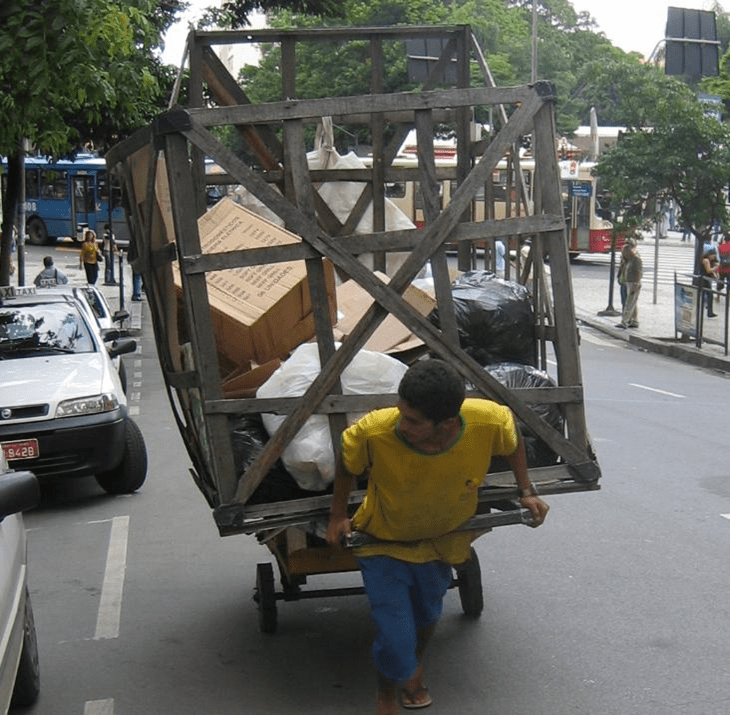
Julio pulling his cart up Rua Bahia with paper from the Ministerio da Fazenda and INS building.
So I stop there at Goitacazes. Bahia and Goitacazes. I wander all over there. I ascend Rua Bahia and leave my cart below because it is very heavy when I arrive at the incline. So I have to leave it below and I grab one of these large nylon sacks, dragging it, I go as far as Savassi on foot, dragging this here, looking for plastic bottles, paper and cans. I go there to the top and return, dragging this on the ground, just pulling it.
I pass Rua Bahia and Goitacazes every day. I have regular stops there: the Mercantil building, the INS, the bingo house, Itau, Bamerindus… there are many there. I go inside the buildings and grab their trash. And it’s like this, I have already picked up stuff there for more than 15 years, right? If I am absent one week, people start to talk, “You disappeared, what happened?” On average, it is ten, eleven at night that I am returning to ASMARE. On average I return with some 600 to 700 kilograms (1,300 to 1,500 pounds) (17). I throw everything in our box. Then I go home. Sometimes I arrive at home at two in the morning. It is very tiring. It’s like, the weekend arrives and you already start to feel pain here, pain there… so I pass some ice to alleviate the pain a little, because you exercise a lot, you work out. I arrive at home, my wife gives me a massage to put my muscles back in the right place.
Weather and Accidents
For me it is normal, rain or shine, either way. Raining or not, you have to go. Of course with sun it is much better because working in the rain your effort is greater. When it rains, paper gets wet. It doesn’t get 100% wet, but 40% gets wet. It’s more tiring because you have to use more force to pull a wet cart, it is heavier than when it is dry. When it is hot weather, you stop if you need to recoup your energy, you go drink some juice, coconut water, a beverage… When it is raining, no. Rainy weather: the quicker you finish the better.
Sometimes an accident happens with one of our work colleagues. We imagine that one day it can happen to us: a car, a bus, hits our cart. Right here, before there was a traffic light, many colleagues have been run over here. They didn’t die, but they remained in serious condition in the hospital for a long time, understand? Thank God, in all these years that I have worked, this has never happened to me. It is very dangerous, like it requires that we double our attention because we sometimes move with our carts on the wrong side of the road. I myself leave here and say “In the name of the Father,” for God to take me and return me… understand? Sometimes we are pulling a full cart and many drivers don’t obey the traffic laws. If a car comes and hits the rear of our cart only God knows what is going to happen. Like, when a car approaches and slams on its breaks, we let go of the cart and run for the sidewalk—this has already happened to me. My wife is religious. She goes to church, meetings and everything and she demands that I go to. It’s like I say, “With God the situation is already difficult. Without Him it is going to get even worse.” So I ask her to pray for me, that God gives me a lot of strength, health, for us to deal with life. My greatest fear is this in the streets. I leave with my cart, my wife stays here waiting for me, the hour passes and she is already worried, understand?
The Materials (Recyclables)
Copper. Copper, like, is a very difficult material to find. I still have to melt it to make money. I pile it up, I don’t sell small amounts. I sell it for R$11.80 per kilogram (US$2.28 per pound) (18). I find it in trash bags in the middle of paper. It’s that business, let’s suppose, if there is a box of this here, many don’t want to throw it away. They call you and say, “How much will you give me for this box of wire?” Because it is a very coveted material, like cans, like metal. I call this here “fine material.” What’s fine material? It’s the same thing as gold. You find a sack like this of gold, you are rich. If they ask, “Do you prefer a sack of gold or a sack of cotton?” Of course it is the sack of gold, right? The most expensive material is copper.
Metal. Metal comes in second place. Metal is six and change per kilogram (more than US$1.15 per pound). Metal is a faucet, is a metal chair, hinges, understand?
Aluminum. Aluminum is this here: cans. I deliver this here for R$3.30 per kilogram (US$0.64 per pound). Cans. There is a difference for hard aluminum, which is less because it is a cheaper aluminum. It is in the area of R$2.00 to R$2.50 (US$0.39 to US$0.48 per pound).
Batteries. Batteries are cheap. It is one real per kilogram (US$0.19 per pound), the battery, and without the water, right? You have to remove its water.
Lead. Lead is cheaper, it is fifty cents per kilogram (US$0.10 per pound).
Plastic. There is PET. PET is thirty five cents per kilogram (US$0.07 per pound). PET are those plastic beverage bottles.
White paper. White paper is nineteen cents per kilogram (US$0.04 per pound). White paper and plastic are the most common materials.
Cardboard. This here is twelve cents per kilogram (US$0.02 per pound), this here is thick cardboard. Now, there is another that is six cents per kilogram (US$0.01 per pound), fine cardboard.
Iron scrap metal. Iron scrap metal is ten cents per kilogram (US$0.02 per pound). Scrap metal… we say iron scrap metal when a magnet clings to it. Now, when a magnet doesn’t stick, it could be steel inox, right? A magnet doesn’t stick to steel inox. A magnet also does not stick to aluminum.
Newspaper. Newspaper is five cents per kilogram (US$0.01 per pound). It already was higher, right? This is the current market value.
Magazines. Magazines are two cents per kilogram (less than a half US penny per pound). It is the cheapest that exists. Like, they buy it to buy it. But it is not worth it, no.
Bingo!
I have already found money, I have already found drugs in the trash. Like, there is a story here, but I don’t like to remember it, no. I would go there to a bingo house on Rua São Paulo. Now it is closed. Every day I would arrive at seven in the morning. When I picked up trash there, I took everything: paper and trash together. I had to bring everything. So, one day I arrived there and police, investigators were inside the bingo house.
I arrived there, they guy said like, “Wait a little because things are kind of ugly here.”
I sat there and after little while security came. The people said, “Who’s this?”
“The young man who picks up trash here,” he said to the people from the municipality.
“Ok, you can let him go. It’s only trash?”
“Yeah.”
So there I am carrying the trash way on top of my cart and I am passing peacefully through downtown, I arrived here and said to my woman, “Things are ugly there at the bingo. It is full of police, inspectors from the municipality. They closed the bingo, they are going to close the bingo.”
I told her, “Don’t mess with this paper here because I am going to see if there is something of value because it was full of police there.”
It seems like I already knew, you know?
So it was that business, on Friday, running here and there, she goes and separates the paper, throws the paper normally in a large container there. After a little while the phone rings.
“You are Julio, the guy who picked up trash here at the bingo?”
I said, “Yeah that’s me.”
“Ah, and what did you do with the paper? You didn’t sell it, did you?”
“No, the paper is here, inside a large container here.”
“No? For the love of God, there are some documents there, the men are pressuring everyone here. Keep it there, don’t sell it.”
So beautiful, the guys arrived here with a car, three security men, they carried away my container of paper and said, “Later you can come and pick up the paper.”
The next day I went there, picked up the paper, and the security guard said to me, “You missed an opportunity to change your life.”
I said, “Why?”
“You left here with more than R$100,000 (US$42,500) inside your cart, crossed downtown Belo Horizonte and you didn’t know you had that money there.”
I only received my paper in return. One hundred thousand reais! They threw it in the trash, they used me as an unknowing accomplice. Of course if I had separated, I would have found it, because I look at everything. It’s that business: an envelope, like, I put my hand in it, because it sometimes comes with money. I look at everything. They didn’t give me one penny, not even one cent! The only thing that they gave us there was a cesta basica every month.
The Salary
I earn two wages, more or less it is this (19). Two wages to pull all of that weight. I think it is little. Very little. But, at the same time I think it is fair because there isn’t any other work for me to do. Understand? An opening appears, they want experience on your work card. And you don’t have it. When you have experience, sign up there to earn R$350 (US$149 per month)? It is better to stay here, where you don’t have anyone to boss you around. You arrive here, you work the hours you want, bring materials there, weigh them, receive money. They pay every week. Every day, if you want. But I weigh every week. It’s that business: if we work a lot, we earn a lot; if we work little, we earn little. For example, I didn’t work last week. I became ill. I earned just two reis (one dollar).
Costs of Living
I pay R$150 (US$64 per month) for rent. I pay for water. The house is full of kids so I really spend on water. Water is in the range of R$80 (US$34 per month). R$150 and R$80 is R$230, right? Food, gas… for my four children, my wife, my step-son and his wife, their daughter… it is difficult. Of course, we want to put good things inside our house. We have to pay for the television for my wife, 29 inches, understand? We bought it on an installment plan. We have a washing machine too. Everything on installment. So, it’s like this, I earn money, but I am already crazy to improve my salary. Sometimes we become sick and everything, but the bills don’t want to know if we are sick or not. The arrive on top of us. Others don’t want to know if you are ill: payment day arrives, they want to receive. If you are sick, ASMARE has a plan with a pharmacy here. We buy now and pay later, they give you a period to pay. This here is a job that stresses you. Sometimes you work so much! You go to receive your money and there isn’t any money. Why? Because in the middle of the month you needed money. Today you are paying. In the month that you most need money, then they discount what you needed in advance. Really, when you are sick, they arrange everything. But it is that business: they are going to discount it on what day? Sometimes, you really need that money, but you already scheduled the day that they will discount it, so end of story.
I live renting. The money that I am spending on rent, I could be putting into savings for my kids for later. I am using it. Imagine how many months, there, depositing R$150 (US$64). When they need to enter school, imagine: I wouldn’t need to search for money. If I had my own home, the money that I spent on rent I would be able to give to them, thinking about their future. At the moment it is difficult to save. But I try my faith also, Telesena, or Megasena (20). Because who knows? Who knows if I knock on the door? Telesena, I already hit the crossbar twice. Who knows if one day I win some twenty thousand? I don’t need more than this, no. It’s enough to build a small home of my dreams tranquilly.
Inequality
How much does a city council member earn per month? He probably is earning in the range of ten to twelve thousand reais (four to five thousand dollars). So, you see how much a wage earner makes per month: R$350 (US$149). So there you already can see the inequality. There isn’t any comparison. Sometimes you want to give good things to your children but it isn’t possible. Why? Because you earn little.

Julio

Julio
So, you turn to one side: there you see the son of a representative with a mountain bike, with roller skates, with this and that. And you stop and think, ‘Why is this? Is it really because the guy studies? No. It is because of the inequality that exists in our country.’
Julio’s Wife
My wife also worked with paper. I met her at another recycling warehouse. I dated her daughter. Her daughter is 25, the age of my youngest sister. Only her daughter did not want to take me seriously. So I saw that there wasn’t any way it would work and her mother saw this and said, “I am going to take him for me.” I went to live with her when I was a child. I was 16. She already had seven kids. Today she is 43, but young. We have been together until today.
At the start I thought it was very difficult because she already lived with another man. He had a problem with drinking… A wife needs attention too. On the weekends, the guy would go out with friends, left the woman at home. My mother didn’t agree with our relationship, my sisters, you know? They said she is too much of a woman for me, her husband wanted to kill me. People gossiped in my mother’s ears, saying that her husband would kill me, that her husband was a dirty animal, but I was never afraid. It’s like this: a dog that barks but doesn’t bite. Like I say, “I was born one minute, I am going to die the next.” If we know that we are going to die today, everyone would be afraid. But we never know. I hope it is far way. Real far away from me! Anyways, he ended up leaving, living there.
I was a child, but I grew up quickly. Like I said, I started to work as a five year old, understand? So then, time was passing, we were falling in love, liking one another a real lot, understand? I got to know her more, she got to know me more, we exchanged experiences. Many things that I thought were difficult in my life I called her, “Shucks, I’m not able to do this. I want to know how it is that you do it, so agile, so easily. Maybe because of your age, you have more experience. So pass it on to me.” This is where she came and explained things to me. Like, many things I know, I learned from her, understand? Many things that she came to know, she learned from me. So, we put together our experiences and are together until today.
Julio’s Children and Step-Children
We have marvelous kids. All of them live with us. Grandchildren too. She has some grandchildren and we have already lived together. Twenty two people lived in just one house. It’s not a big house, but like, one more always fits in. One package of rice is gone with lunch, another with dinner. Now we are ten (21). Today I take care of two step-children, they are my wife’s kids. We have four children together. The oldest is 12, the others are 10, 7 and 5. The youngest is a boy. The other three are studying. My little boy is at a crèche. Next year he starts studying. When my children grow up, I have this here to show that I did not have the greatest comfort in the world because my life was this (22). But look at the comfort that I give you: I don’t bring you to work, I don’t demand this or that. What I demand of you is to study. This I require.
If the school grade is worth ten, I want them to get twenty. Do you know why? For tomorrow, for them to demand this of their own kids. So this is what I want because if my mother and my father demanded grades of me in school, today I could be a graduate, could be there working at a good job, understand? And helping even my father because as we get up in age, the body doesn’t work, there are medications. What the government gives for retirement practically goes entirely to medication bills. So, today we need to think about the future of our kids. What I can do for them, while I am alive, for their studies I will do.
A Refection
I think like this, “If I hadn’t come here, if I had stayed in São Paulo with that family that took in me, my brother and sisters, would I have built this marvelous family here, would I have been with another family there?’ So, there are times I stop and reflect. So, when I remember that stuff of my mother, when we left for Belo Horizonte, I ask, “If we were there in São Paulo, today would I be a catador of paper?” And these people who helped us, “If they saw us today, would they recognize us? If I see them, would I recognize them?” I have a desire to see them, like, to thank them for what they did for me and my family.
Five Star Hotels
With the group Armatruques, a group of puppeteers, a theater group here in Belo Horizonte, I received an invite to go with them to other cities to talk about my work. I never imagined this in my life: a poor kid, who lived in the streets, below bridges, beneath canopies, in old homes to be there. Man, I went with them to various cities. And we stayed just in five star hotels. Do you know what a five star hotel is? I entered for the first time, like, I had to close my chin. My chin fell like this. I couldn’t believe it! Enter in a restaurant that I never imagined, got to know a city that I never imagined. I had this opportunity. Only I wanted to record that moment for when my kids grow up to show them. I wanted at that minute to have a movie camera, a camera to take pictures to remember that I was there. Understand? To tell them, “Your father, my children, didn’t have money for a house, didn’t have money for us to build an adequate future, your father didn’t have money for this or that… but I went to places you can’t imagine. I went to places that I never would have imagined. Do you know why? Because of my friends.”
Breakfast at the hotel, I couldn’t eat, no. I wasn’t able to. It was crazy. In the streets, I ate fruit that I grabbed from the trash. That would go straight back to the earth. I would eat leftovers. The hotel had yogurt, juice, just good things, how do you say, to restore proteins that the body needed. But I wasn’t able to enjoy them because I am the type of guy like, very moved by things. I had all of that to eat at breakfast, but did my children have a piece of bread to eat home? I thought about my family, about my children. If I could have grabbed that and brought it to them, I would have, I really would have, because it is like this: I don’t want happiness just for me.
Health, Happiness, A Dream and a Desire to Write
Happiness is just to get up. To be lying in bed and know that I am getting up healthy to be able to work, to see my children healthy also, my wife, understand? Because money does not bring happiness. Money comes after. First it is our health, our children’s. Money comes after because I can have a truckload of money here, but if I am stuck in bed and not able to get up, it’s not worth anything. No, first it’s my health and that of my family. My dream is to conquest my own home because sometimes I fight to modify something and I can’t. Understand? My bathroom: I have a desire to put a bathtub in the bathroom. To take a bath, my God, it is really good. Like I say to my wife, I arrive here tired at home, but really exhausted… you turn on that water there, enter to your stomach, read, relax, put on quiet music for you to think about just that moment there, you know? Stay some two hours there, just relaxing your muscles, understand? I want that… But for me to want that, I have to have my own house so I can make it the way I want.
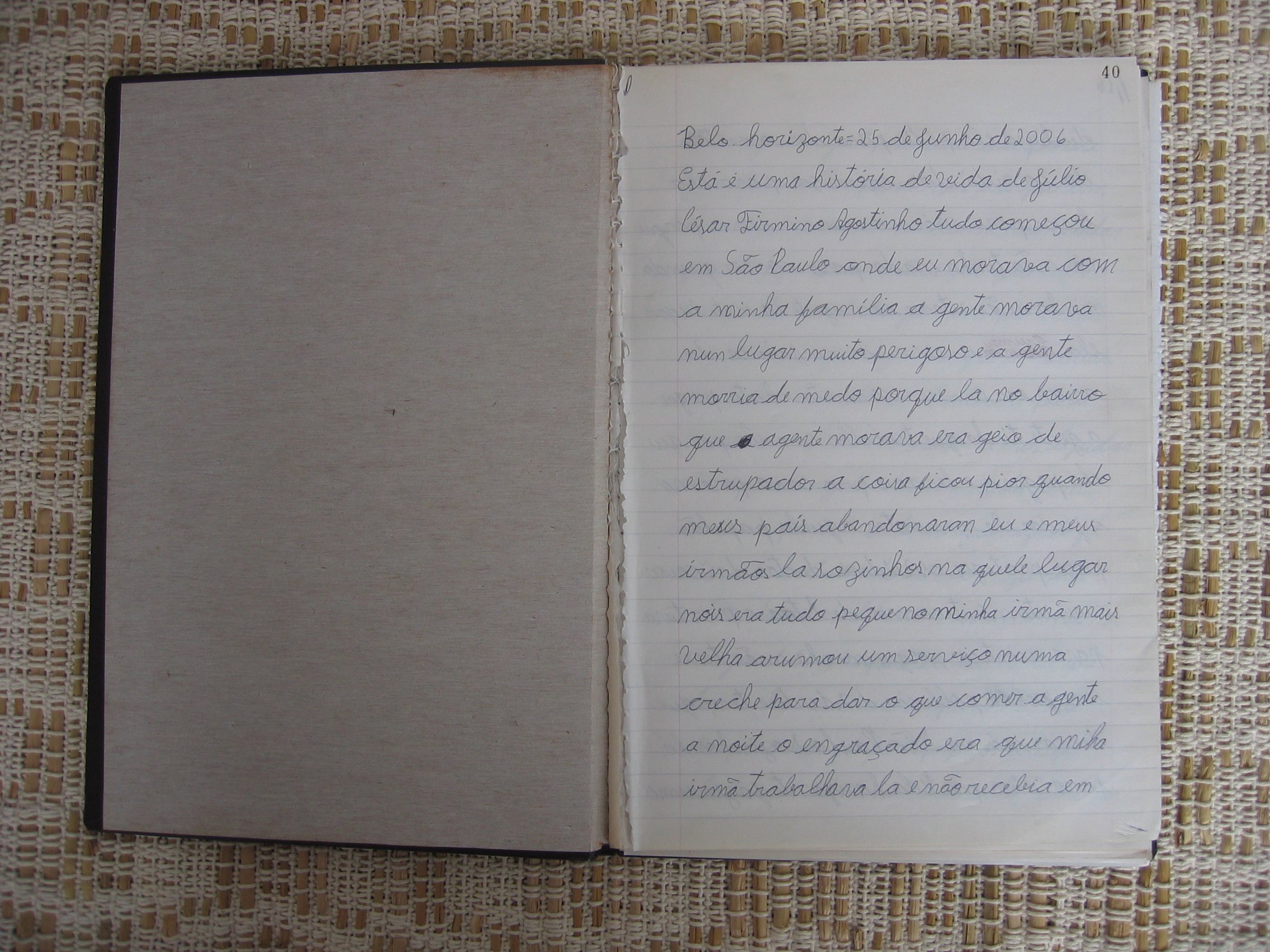
Julio’s notebook
My God, what desire I have to write a book! It’s possible to write. What I have said is not something I am inventing, no, they are serious things, things I feel, that I pass day to day. It’s like this: sometimes we say, “I am anguished, I am going to go up that building, I am going to jump from the twentieth floor.” Sometimes the guy jumps from the twentieth, just breaks a leg, bends his neck and doesn’t die. So then, I was upset with life, I didn’t know what I would do with my life, I said, “You want to know something, I am going to write. I don’t want to open up to anyone.” So, I resolved to pick up a notebook and write. I wrote, like this, how I am speaking. My writing isn’t very good. I am good at math and science. I wasn’t a big fan of Portuguese. Portuguese, for me, I am terrible. Anyways, I shared my story.
« end »
Please feel free to comment on Wandercy’s story.
(1) “Barra pesada” literal translation: “heavy bar.” In Brazil, this phrase can refer to a perilous place.
(2) Julio is referring to his oldest sister, who was eight or nine years old at the time.
(3) As an outside observer, I am suspicious about the circumstances of his mother’s sudden departure.
(4) A “cesta,” or “cesta basica,” is a basket of basic monthly supplies that the average lower-middle-class family needs to survive.
(5) After more than two years in Belo Horizonte.
(6) “Fiscal” refers to public employees who monitor street irregularities and enforce city rules and regulations within Belo Horizonte.
(7) Guarana is a small fruit, naturally high in caffeine, from the Amazon. Powdered guarana is mixed with water to create an instant drink.
(8) A food market in downtown Belo Horizonte. At this time, Julio was about five years old.
(9) “Pivetes” refers to child thieves.
(10) Savassi is a middle- to upper-class neighborhood in Belo Horizonte.
(11) “Mendigo” refers to a beggar.
(12) Restaurante Popular is a city food service that offers meals to Belo Horizonte’s needy for R$1 (US$ 0.50) per plate.
(13) A covered space for catadores to separate trash, protected from rain and sunshine, and where they could store their carts and recyclable materials.
(14) Pastoral da Rua refers to a movement, or group, of street people organized by religious leaders in Belo Horizonte.
(15) An upper-class neighborhood nestled in Belo Horizonte’s mountains, relatively far from downtown.
(16) A box refers to one of ASMARE’s various stalls allocated to catadores. It is a private space where members separate trash from recyclable products and clean and prepare recyclables for weighing.
(17) Includes the weight of his cart, recyclable materials and non-recyclable trash.
(18) Material prices per pound based on an exchange rate of R$2.35/US$1.00 during second half 2005.
(19) US$3,575 per year based on estimated earnings of R$700 per month and exchange rates at the time.
(20) Brazilian lotteries
(21) Ten includes: Julio, his wife, their four kids, two of Julio’s step-children and the wife and child of one of his step-children.
(22) Julio is holding a notebook in which he wrote about his life.